
PNA Spotlight: Georgios A. Zenonos, MD FAANS
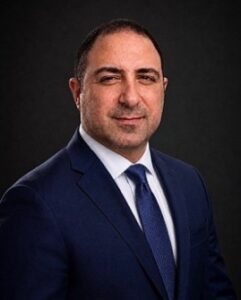
Excellence, and Center for Cranial Nerve Disorders at the University of Pittsburgh Medical Center Neurological Institute. Dr. Zenonos received Georgios A. Zenonos is the Neurosurgical Director of the Center for Cranial Base Surgery, Pituitary Center of his medical degree from the National and Kapodistrian University of Athens School of Medicine.
He undertook post-doctoral research fellowships at Harvard Medical School in 2010 and at the University of Pittsburgh in 2011. He stayed on and completed his seven-year neurological surgery residency training, as well as an enfolded fellowship in endoscopic and open skull base surgery at the University of Pittsburgh School of Medicine. He then went on to complete a fellowship in skull base and cerebrovascular surgery at the University of Miami. Dr. Zenonos was kind enough to answer some questions from the PNA. His answers follow.
Please tell us why you chose to specialize in neurosurgery?
I was always intrigued by our nervous system and the brain in particular; they are sort of what makes us who we are. Even in medical school, one of the things that interested me the most was learning about brain and its functions. The surgical specialties were more appealing to me, because you can make a big difference for a patient. It seemed like we were almost preparing to go to war, where it was you and the patient against the disease. It was more physical, and direct way to help patients. In surgery, there is no hiding. The effects of everything you do are so immediate and direct, so it’s quite more gratifying.
Tell us about your early education.
I grew up in Cyprus. Everyone there must do military service after high school. I completed a 26-month period of military service, where I served as a military officer, and then went straight to medical school at the National and Kapodistrian University of Athens. Medical school in Athens is a six-year program.
I then completed a post-doctoral research fellowship in Boston at Harvard Medical School, and then moved to Pittsburgh for my residency, as well as a skull base fellowship, focusing both on endoscopic approaches and open approaches. I then moved to Miami for one year for an additional fellowship in cerebrovascular and skull base surgery. I moved back to Pittsburgh to join the faculty in 2019.
Who have been your mentors along the way?
Multiple people have been important mentors. Drs. Jacques Morcos and Roberto Heros in Miami, and in Pittsburgh Drs. Juan Fernandez Miranda, Paul Gardner, Carl Snyderman, and Eric Wang.
What would you like people to know about your practice, and UPMC’s approach in general?
UPMC has a long history with pituitary surgery. It was the first multidisciplinary skull base center in North America and the birthplace of endoscopic endonasal approaches. Many of the complex endoscopic procedures were pioneered here. A multi-disciplinary approach has been in UPMC’s DNA from the beginning. So, in our institution, all the disciplines have worked together over the years to grow the field, pushing the boundaries of what can be done. Techniques have been refined to improve both the effectiveness and the safety profile of treating complicated disease processes. Every year, several patients from across North America and the world travel to Pittsburgh to be treated at our skull base center. I feel very privileged to be able to practice here with such an amazing team of colleagues and deliver such excellent care for our patients.
In general, what should people know if they are a candidate for pituitary neurosurgery?
It is paramount to try and find a center where pituitary surgery is approached with the seriousness it deserves. Although there are simple pituitary tumors, not all pituitary tumors are simple, and the more complicated ones require a team well-versed in skull base endoscopic procedures. This is very important, as most pituitary tumors are benign and potentially curable. This is even more impactful for functional pituitary tumors, such as prolactinomas, Cushing’s disease and acromegaly, where removing every cell is crucial. It has been common practice in earlier times to remove parts of these tumors, and then patients went on to have radiation or lifelong medical treatments, often with suboptimal results. With advanced endoscopic techniques, and sometimes the combination of both endoscopic and minimally-invasive open approaches available at a comprehensive skull base center, complete resections that are safe and easy on the patient are usually the norm. Separating the patient from the disease is liberating for both the patients and their families.
Also, I would highlight the team aspect of pituitary treatment. It starts from having the appropriate imaging, then having a good endocrinologist who can really pinpoint whether something is functional or non-functional, and where it originates. Skilled ENT skull base surgeons can work with the neurosurgeons towards removing the tumors. Good ICU care is important, as is a multidisciplinary approach on the floor to manage any post-operative issues that could arise. The entire treatment team is very important, including post-operative care with appropriate follow-up and nasal care.
What would you consider to be the future of your field? Where are things going?
We must continue to refine our surgical techniques, but more importantly, there will be advances in understanding the disease process, such that hopefully at some point we will not need to do surgery on many of these tumors. In some of the most challenging tumors, where they’re difficult to treat surgically, we will be able to better devise targeted therapies to address them more intelligently.
What led you to join the Pituitary Network Association?
I think that the PNA is a wonderful resource for patients. It gives patients access to information that’s relevant to their disease, and the opportunity for surgeons to share their experience and perspectives. In many ways, it democratizes access to information and appropriate care for pituitary diseases. It’s truly a unique resource.