














Nominate for Gentle Giant Award!
Do you have a pituitary HCP who has made a profound difference in your care or your life? A real “Gentle Giant”. We want to hear about them! Help us recognize the amazing professionals who go above and beyond by nominating your favorite doctor. Your story can help shine a light on the heroes in our community and inspire others on their journey. Submit your nomination today—we can’t wait to celebrate them with you!
Don’t Miss Our Exciting Upcoming Events!
Discover Leading Professionals and Specialized Services in Healthcare
Search
Recent Webinar
Patient’s Corner
Introducing Patient’s Corner, a place for you, the patient, to share your stories. If you have a story you would like to share please contact us below.
Patient story:
Panhypopit patient in a bind as Humatrope is discontinued
Tara Cummins, a pituitary patient in Klamath Falls, Oregon, says she’s at her wits’ end because the medication she depends on, Humatrope, is being discontinued by pharmaceutical giant Eli Lilly. Humatrope is Lilly’s version of somatropin, used to keep people like Cummins alive. Cummins suffers from panhypopituitarism, which developed after pituitary failure soon after a hysterectomy done in 1992 to counter painful recurring ovarian cysts. She also experienced pituitary failure.
Cummins has no health insurance because she makes too much to qualify for Medicaid and cannot afford to buy insurance on the individual market. In addition, when she had insurance, it didn’t cover the medication she needed. She sued the insurance company, saying, “Policies are allowed to be changed and modified to under-cover conditions or medications or exclude treatment for certain conditions. Early on after my settlement with the insurance company (where I still maintained my policy) they changed the terms of the policy, leaving me with a choice of having insurance but not coverage (or adequate coverage) for the somatropin which left me with out-of-pocket expenses that almost no one would be able to afford. With no insurance, I could qualify for patient assistance directly through the manufacturer. The term used was being under insured; as if I had any option to be more insured.”
So, Cummins has been paying for doctor visits on her own and she relies on Eli Lilly’s patient assistance program for free access to her medication: 1 mg each night. At age 63, it’ll be a little more than a year before the retiree qualifies for Medicare. In the past, she took Pfizer’s version of the medication, Genatropin, but Pfizer discontinued its patient assistance program two years ago, and the medication costs between $5,800 and $16,000 a month if you don’t have insurance.
Cummins says she hopes to get one more shipment from Eli Lilly, which would last her about four months. She says she’s been told that her life expectancy without the medication is about two years.
Complicating matters, Novo Nordisk’s Norditropin Flexpro subcutaneous solution for injection, is on shortage as of September. On ashp.com, the shortage is attributed “to increased demand and manufacturing delays.” The site notes that Ferring has Zomacton available; that Genentech discontinued Nutropin AQ Nuspin presentations in December 2024; that Pfizer has Genotropin available (but discontinued the patient assistance program); and that Sandoz has Omnitrope available.
In addition, Cummins had her thyroid removed and relies on natural thyroid medication. However, the FDA announced in August that it wants animal-derived thyroid medications off the market because they are not FDA approved and “contain many compounds that are uncharacterized for safety and effectiveness.” The FDA estimates that “1.5 million patients received prescriptions for these medications from U.S. outpatient retail pharmacies in 2024.”
PNA Spotlight: Dr. Chandan Krishna
This month, the PNA Spotlight focuses on Dr. Chandan Krishna, an endovascular and skull base neurosurgeon at Mayo Clinic Arizona. He earned a Bachelor of Science in Computer Science from the University of Houston. He completed medical school at the University of Texas Medical Branch in Galveston, Texas, and a residency in neurosurgery at Methodist Neurological Institute in Houston. He also completed a neuro-endovascular fellowship at the State University of New York in Buffalo. Dr. Krishna answered a set of questions from the PNA. His answers follow.
Please tell us why you chose the field of neurosurgery.
The pituitary gland fascinates me because, despite its small size, it has an enormous impact on the body’s function. Pituitary tumors also require a unique surgical approach. Through transsphenoidal surgery, we can often access these tumors through the nose without making a visible incision. Working closely with our ENT colleagues, we can treat patients in a way that minimizes disruption while making a meaningful impact on their quality of life.
Being able to restore vision, improve hormone function, and help patients return to normal activities is incredibly rewarding.
Tell us about your medical education.
My education is somewhat non-traditional for medicine. I completed my undergraduate degree in computer science in Texas, and then I decided to pursue what I like to call the real computer of the human body: the brain. I attended medical school at UTMB in Galveston, Texas, then pursued neurosurgery through residency training at Methodist Hospital in Houston’s Texas Medical Center. Afterward, I completed a two-year fellowship in endovascular surgery in Buffalo, New York.
I then joined Mayo Clinic Arizona, where I’ve been for the past 11 years.
Over that time, our pituitary program has continued to grow, supported by a highly collaborative, multidisciplinary approach to care. At Mayo Clinic Arizona, patients with pituitary conditions may be evaluated by endocrinology, neurosurgery, neuro-oncology, ENT, and neuro-ophthalmology, depending on their individual needs.
We review cases together and develop an individualized treatment plan, which may include observation, medical therapy, surgery, and/or long-term surveillance. Because pituitary tumors can affect vision, patients may also be evaluated by neuro-ophthalmologist Dr. Marie De Nome. In many cases, an enlarged pituitary adenoma can place pressure on the optic chiasm and affect peripheral vision.
After a comprehensive evaluation, some patients require routine follow-up imaging and monitoring, while others may benefit from surgery if the tumor is growing or causing symptoms.
Who have been your mentors?
There have been many mentors throughout different stages of my life, both inside and outside of medicine. My colleagues here at Mayo Clinic Arizona have been mentors, as have many of my colleagues in Rochester. We collaborate closely, learn from one another, and continually challenge each other to provide the best possible care. That exchange of knowledge and experience helps all of us become better physicians.

“The next phase of innovation will involve wider adoption of 3-D endoscopic technology. Currently, surgeons perform these procedures using 2-D imaging, and we have become highly skilled at operating in that environment. However, 3-D visualization has the potential to improve depth perception and surgical precision.”
PNA Gratefully Acknowleges Our Supporters





Get Involved
If you wish to donate, contact:
- P.O. Box 1958, Thousand Oaks, CA 91358
- Office: 805.499.9973
- Fax: 805.480.0633
- Email: [email protected]

Coming Events

Volunteer With Us

Pituitary Patient Toolkit
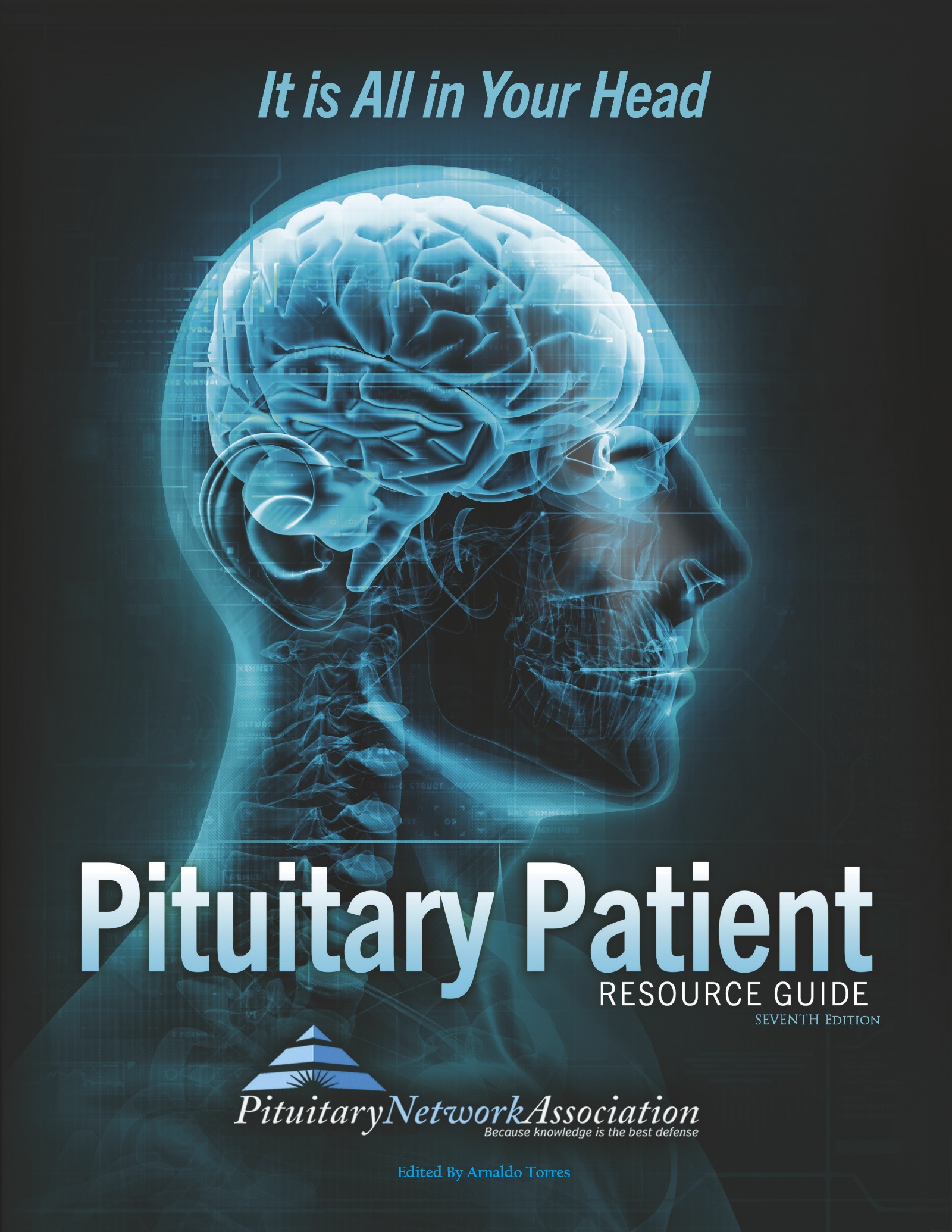
Seventh Edition - Now Available!
The Pituitary Patient Resource Guide Seventh Edition is now available! Be one of the first to have the most up-to-date information.
The Pituitary Patient Resource Guide a one of a kind publication intended as an invaluable source of information not only for patients but also their families, physicians, and all health care providers.
It contains information on symptoms, proper testing, how to get a diagnosis, and the treatment options that are available. It also includes Pituitary Network Association’s patient resource listings for expert medical care.
Latest News
Dopamine Agonists
Medications with predominant effects on pituitary cells that harbor receptors for the chemical transmitter dopamine. Examples include Bromocriptine and Cabergoline.
Doppler Ultrasonography
An application of diagnostic ultrasound used to detect moving blood cells or other moving structures and measure their direction and speed of movement. The Doppler effect is used to evaluate...
Edema
An accumulation of an excessive amount of watery fluid in cells, tissues, or serous cavities (swelling). Edema means swelling by an excessive amount of watery fluid accumulated in the intercellular...